
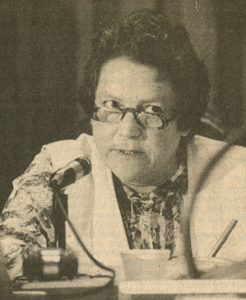
Courtesy Nevada Historical Society
BARBARA JEAN PETERS BENNETT
The information below has been compiled from a variety of sources. If the reader has access to information that can be documented and that will correct or add to this woman’s biographical information, please contact the Nevada Women’s History Project.
At A Glance:
Born: July 25, 1923 Oakland, California
Died: March 31, 1993 Reno, Nevada
Maiden Name: Barbara Jean Peters
Race/Nationality/Ethnic Background: Caucasian
Marrried: John A. Bennett
Children: Sherry Bennett Gordon, John T. Bennett, Linda Bennett
Primary City and County of Residence and Work:
Reno, Washoe County, Nevada
Major Fields of Work: Mayor of the City of Reno, political and community activist
Other Role Identities: wife, mother
First female Reno mayor championed children’s welfare, women’s rights, growth limits
Biography:
Barbara Jean Peters was born on July 25, 1923, in Oakland, California, to Paul Peters and Irene Heffron. A son, Harland, had been born in 1922 but had lived for only 9 months, so upon Barbara’s birth she became the eldest of two children when her sister, Norma, was born two years later. Life in the Peters household was difficult. Both parents had married young and struggled financially. The Peters were no longer living together by the time Barbara was 4, and she relates a somewhat harrowing early childhood before and after the divorce. According to her oral history, the girls were sent back East to live with relatives, and when they returned her parents were no longer living together. For a time she and her sister were placed in an orphanage in Oakland but by the 1930 census both girls were living with their father in their uncle’s Oakland, Calif., home. She and her sister lived with her aunt and uncle for four and a half years.
In 1931 Paul remarried and Barbara and Norma went to live with him, his new wife and her two children. Their father was seldom home and the girls were abused both physically and mentally by their new stepmother who most likely resented having to raise two children she never wanted. The girls were isolated from their aunt and uncle, and at age 13 Barbara, who had run away from her stepmother’s home before, ran away from home for good. She found a job caring for children and keeping house while at the same time being allowed to attend school. Her father discovered where she was living but didn’t force her to her to return home. She later worked for a doctor and his family until she finished high school in 1941 when she went to work for the AT&T telephone company. In December 1941, the United States entered the war and Barbara went to work in the defense industry in the Bay Area. (1)
After the war ended, Barbara met and married her husband, John A. Bennett. They began married life in Oakland, Calif., but shortly thereafter moved to Sacramento, Calif., where their three children were born: Sherry in 1947, John in 1949 and Linda in 1950. She related that this time in her life was difficult as she was unprepared for motherhood having no suitable role models. She let her children do whatever they wanted and punishment was simply not forthcoming. In 1989, reflecting back on her parenting skills, Barbara voiced the thought that her kids probably would have said she could have been a more firm parent. In the early 1950s, however, she was a stay-at-home mom coping with three small children and trying to make ends meet. Shortly after the birth of her youngest children, Linda, Barbara returned to the workforce but not in a job she “wanted to stay with.” At the time her husband was also working for the government, but in 1964 they decided to relocate to Reno, Nev., where John’s brother had a plumbing business and had offered John a position as an expediter. Once relocated, Barbara went to work for the Nevada Bell telephone company.
In 1965 at age 42, Barbara suffered a massive heart attack. She spent three weeks in the hospital and another three months recuperating but with three teen-age children and a now reduced household income, it was time for her to return to work for the telephone company. Women’s rights were now being discussed nationally because women often found themselves training young men who subsequently became their bosses. She stated that “between my age and the policy of promoting minorities, at that time, I was really kind of locked in at the telephone company. The minority thing didn’t bother me because as part of the Nevada Women’s Political Caucus, we were working with those kind of things.”(2)
In 1975, she left the phone company on a sour note after believing she had been subjected to age discrimination. Although she had collected documentation substantiating that fact, the Bennetts simply did not have the finances to pursue a long legal suit. She submitted her resignation with a copy of her investigation into the company’s hiring practices.
During that time (1967-1971) she was also pursuing law via an extension course offered by La Salle Extension University, a private university based out of Chicago, Ill. She was also working with Maya Miller, Nancy Gomes, Sue Wagner, and Mary Frazzini, longtime women’s rights advocates, to establish the Nevada Women’s Political Caucus and get the Equal Rights Amendment passed in Nevada. Barbara was appointed to the newly formed City of Reno Commission on the Status of Women by Reno Mayor Sam Dibitonto. (3)
The Bennetts lived in a mobile home park, and during the 1970s the rental space cost was increasing at a rapid rate. There were no legal safeguards for renters, and Barbara “with the help of Florence Giraud founded the Northern Nevada Mobile Homeowners Association.” (4) The Association first lobbied the Reno City Council and subsequently the Nevada State Legislature for legislation to help mobile home owners. Ultimately mobile park occupants were assured of timely advance notice of rent increases, and if the park owner sold the property, tenant moving costs were to be paid by the park owners.
In 1973 a Blue Ribbon Task Force Report was generated as a project of the Washoe County Regional Planning Commission. Barbara stated that, not only did she read the ten-volume report once, but in fact multiple times. The report dealt with issues that would affect Washoe County’s future growth such as water, transportation, education, the quality of life and air quality. That report propelled Barbara to run for the Washoe County Commission in 1975 at the age of 52. She lost.
Barbara continued to pursue her involvement in city politics and in 1977 she ran for the Reno City Council. Again she lost. However her name was becoming recognized and associated with limiting growth in the community due to limited resources.
At 56 years old Barbara Bennett had the audacity to run for mayor of Reno against a well-financed, well-known opponent by the name of Bruno Menicucci. Menicucci had been a member of the Reno City Council for years, was a member of the “old boy’s network” in Reno and, most importantly, was a proponent of most things Barbara was not. Barbara, however, had done her homework. She walked the streets and talked with people. She would not accept donations to her campaign from special interest groups and, in fact, would accept only personal contributions. Rollan Melton, a newspaper columnist, wrote that her support came from “senior citizens, teachers, women’s groups and a gaggle of others” who became the voices of the “Barbara Bennett movement.” Menicucci’s loss in his bid for mayor was not only a shock to him but also to the large campaign contributors. Barbara noted it was one of the throw-the-rascals-out kinds of time. (5)
Barbara served just three years as Reno’s first female mayor. On December 23, 1983, Dick Cooper of the Reno Gazette-Journal wrote, “Her views – often unpopular with the business community – were a reflection of what she saw as a mandate from Reno citizens when they elected her mayor in 1979.” (6) Her main concern as mayor was growth (water, water quality, air quality and affordable housing). She also wanted to develop an ethics policy and ensure inclusive citizen participation in their government. Although Mayor Barbara was usually the odd one out and constantly fighting for her beliefs, she ultimately did get an ethics policy passed in 1982. It wasn’t as strong as she had wanted but it was a start.
Seed money for EDAWN, an organization committed to recruiting and expanding quality companies that have a positive economic impact on the Greater Reno-Sparks-Tahoe region, was established by the Reno City Council at the behest of Barbara Bennett. (7) In a March 1993 newspaper article, Susan Voyles wrote, “As mayor, Barbara Bennett was named by Common Cause as one of the country’s top ten politicians as she had lobbied for complete campaign contribution disclosure.” Voyles added, “ Years later, Mayor Pete Sferrazza was quoted as saying Bennett was “scrupulously honest… lived in a mobile home and drove a VW Beetle.” (8)
In 1981 she underwent triple bypass surgery. Real estate developments kept getting approved against her cautions. In 1981, “the Nevada Legislature reduced property taxes in what is known as the “Tax Shift”, whereby cities and counties received less property tax revenue and more sales tax revenue. Nevada made this change to mirror California Proposition 13 along with over forty states nationwide……In doing the proceeding, Nevada moved from basing its revenue structure on a stable revenue source (property tax) to an unstable revenue source (sales tax)”. (9) The result in the City of Reno was a loss of many necessary governance positions. Barbara stated, “It’s always been my contention that if the costs of new growth had been attached at the time that these projects were approved, it would’ve discouraged some of them. Those that it did not discourage would have had to agree to pick up these costs.” (10)
In 1982 she was named to the State of Nevada Commission on Ethics, and in that same year Common Cause awarded her the National Governing Award, one of five national awards for leadership in the public interest. Her comment regarding that award was, “I was shocked, because I didn’t think anybody knew about a little old lady from Reno, Nevada.”(11)
One big accomplishment as mayor that she cited was the establishment of the Reno Planning Commission. She didn’t do this single handedly but it was her leadership that enabled the Reno City Council to agree to the Commission.
Meanwhile, in what Barbara felt was a behind-the-scenes move, a call came from Governor Dick Bryan’s office offering her a position with the State of Nevada. She was making $10,000 a year as mayor, her husband had had health issues and was now on medical disability, they were both in their sixties and not financially secure. She wasn’t currently, never had been nor would she ever be a “political glad hander.” She said she knew she wasn’t going to run for reelection although she hadn’t voiced that thought publicly. So when the call came, Barbara decided to take the position as deputy administrator for the Youth Services Division in Carson City, at a salary three times higher than that of mayor, and began that position on January 3, 1982.
The Youth Services Division dealt with issues Barbara had faced in her childhood. Her concerns were now kids who had been in trouble, kids not in trouble but being placed in foster care, abused children and child care. The administrator was leaving at the time Barbara was assuming her new duties. She spent some time, directionless in her strange new environment, reviewing and making contacts. After a while of dealing with the statistics and putting things together, “a lot of things just hit me between the eyes.” She saw that boys who had committed “serious offenses” were being sent to the Elko Training School and the girls that were being sent to the facility for girls in Caliente “were rarely being committed because of serious offenses.” She talked with District Judge and Juvenile Master Chuck McGee about the problems inherent in sending these girls to Caliente where they would then be exposed to girls with serious more issues like drug and alcohol addiction. There simply was no other place to send these young offenders. She discussed half-way houses and utilizing more probation officers but knew those solutions demanded the Governor’s attention and she wasn’t sure he was aware of the problems and their potential solutions.
In January of 1984, Barbara left her position; concerns about her health and her husband’s, the long hours of 6:30 a.m. – 6:30 p.m., and the frustration of all the “red tape” that usually accompanies a bureaucratic position had just proved to be too much. She stated, “It’s not like being mayor, where I could go storming into the governor’s office or whatever!”
“I was so active for so many years, sometimes at the expense of family gatherings – especially when I was mayor. I really needed to get back to the family and have more time with my grandkids and everyone. I needed less political involvement in my life. You really get a bit burned out after all the years, but I maintain an absolute interest in politics, in the people who serve in office, and government at all levels.” (12)
She left political life to do just that – enjoy her family. Four years after her retirement in 1988, her husband, John, passed away. Barbara Jean Peters Bennett passed away just five years later on March 13, 1991. She was not quite 70 years of age. She was cremated and a memorial scholarship fund was established with the University of Nevada, Reno. In 1993, the Reno City Council honored her by establishing the Barbara Bennett Park located at 400 Island Drive, Reno, Nev. (13)
Researched and written by Marcia Bernard Cuccaro. Posted to website March 2018.
Footnotes
- Barbara Bennett: Mayor of Reno and Community Activist (University of Nevada Oral History Program), Reno, Nevada 1989.
- ibid.
- ibid.
- ibid.
- ibid.
- Cooper, Dick. “Bennett’s tough style fueled by a populist mandate.” Reno Gazette-Journal (Reno, Nevada), Dec. 23, 1982, p 23.
- Day, Kevin T. “Late mayor visionary.” Reno Gazette Journal (Reno, Nevada), Mar. 28, 1993, p B9:4, Sec. Letters.
- Voyles, Susan. “First Reno politician to fight uncontrolled growth.” Reno Gazette-Journal (Reno, Nevada), March 17, 1993, p1:6.
- Stoeckinger, Philip. “Impacts of the tax shift of 1981: An examination of Nevada local governments”, UNLV Theses, Dissertations, Professional Papers and Capstone, University of Nevada, Las Vegas.
- Barbara Bennett: Oral History, op. cit.
- Barbara Bennett: Oral History, op. cit.
- Barbara Bennett: Oral History, op. cit.
- “Reno council votes to name park after former Reno mayor.” Reno Gazette Journal (Reno, Nevada), April 29, 1993, p B1:3.
Sources of Information:
- Social Security Applications and Claims, 1936-2007. (Barbara Jean Peters).
- 1930; Census: Oakland, Alameda, California; Roll: 102; Page: 5B; Enumeration District: 0038; FHL microfilm: 2339837. (Barbara Peters).
- 1940; Census: Alameda, Alameda, California; Roll: m-T0627-00183; Page: 1A; Enumeration District: 1-21. (Barbara J. Peters)
- California Birth Index, 8 Jan 1922, Birth County: Alameda, Ancestry.com California Birth Index
- California Death Index, 1905-1939, Alameda, California, Ancestry.com California Death Index
- California Birth Index, 7 Sept 1947, Sacramento, Ancestry.com California Birth Index, 1905-1995
- California Birth Index, 17 June 1949, Sacramento, Ancestry.com California Birth Index, 1905-1995
- California Birth Index, 24 Aug 1950, Sacramento, Ancestry.com California Birth Index, 1905-1995
- State of California. California Death Index, 1940-1997. Sacramento, CA, USA: State of California Department of Health Services, Center for Health Statistics. (Barbara Jean Bennett)
- Cooper, Dick. “Bennett’s tough style fueled by a populist mandate.” Reno Gazette-Journal (Reno, Nevada), Dec. 23, 1982, p23.
- Day, Kevin T. “Late mayor visionary.” Reno Gazette Journal (Reno, Nevada), Mar. 28, 1993, p B9:4, Sec. Letters.
- Voyles, Susan. “Barbara Bennett dies at 69, Legacy lives on: First Reno politician to fight uncontrolled growth.” Reno Gazette Journal (Reno, Nevada), March 17, 1993, p 1:6.
- “Reno council votes to name park after former Reno mayor.” Reno Gazette Journal (Reno, Nevada), April 29, 1993, p B1:3.