
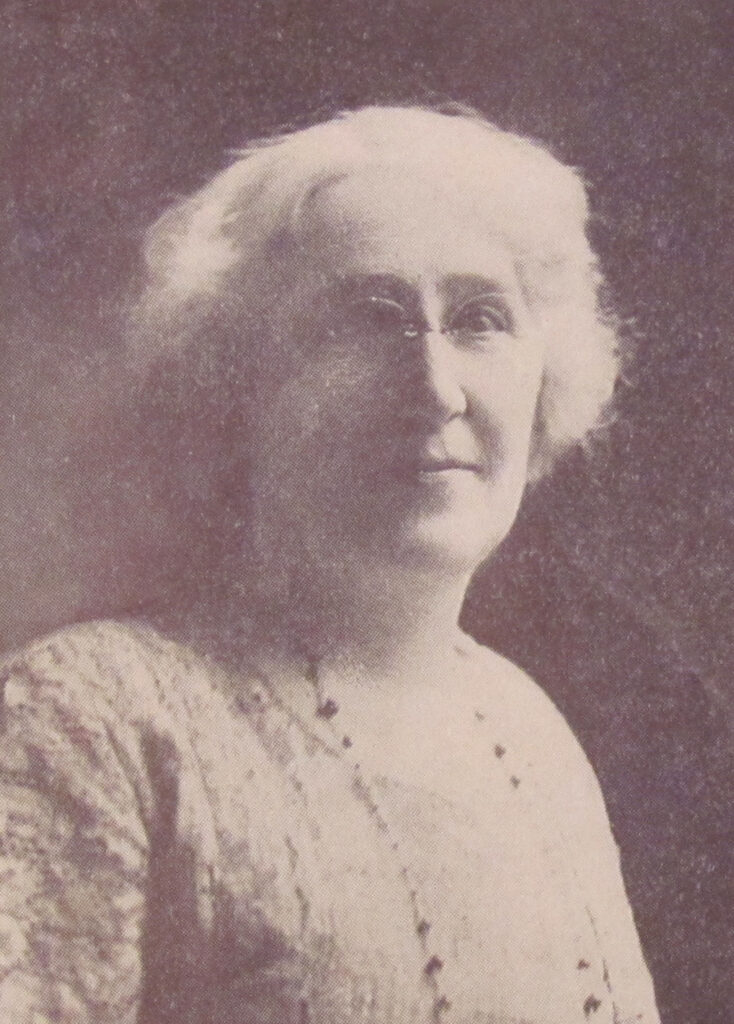
The information below has been compiled from a variety of sources. If the reader has access to information that can be documented and that will correct or add to this woman’s biographical information, please contact the Nevada Women’s History Project.
At a Glance:
Born: September 4, 1863, Pleasant Hill, Missouri
Died: February 14, 1952, Reno, Nevada
Race: Caucasian
Married: Robert D. Eichelberger on September 15, 1885.
Children: none
Primary city and county of residence and work: Reno, Washoe County
Major Fields of work: women’s suffrage, many women’s groups and causes
Biography:
Reno activist battled for women’s suffrage, local issues
Bessie R. Lucas Eichelberger was a passionate supporter of women’s suffrage in the early 20th century who worked tirelessly in many organizations to achieve that end as well as speaking out on many other issues.
She was born to Captain William Lucas and Nannie J. Reese Lucas in Pleasant Hill, Missouri, on September 4, 1863. She was the granddaughter of General Samuel D. Lucas, recorder of deeds in Kansas City in the early days of the country’s independence. At the age of 22, she married Robert Eichelberger and moved with him to Reno in 1900, when he got a job with Wells Fargo & Co.
Before her suffrage activities, she was busy as the matron of Adah Chapter No. 104, Order of Eastern Star. But equal voting rights for women tugged at her, starting about 1910. She was connected with the winning of suffrage for women from the inception of “Votes for Women” as the secretary-treasurer of the Nevada Equal Franchise through the years it took to win.
A member of several organizations, she was voted auditor of the Nevada Women’s Civic League in February 1915. Prominent Nevada suffragist Anne Henrietta Martin was voted president at the same time.
When Eichelberger returned to Kansas City, Missouri, to visit relatives in June 1917, she was amazed at how the town had grown in her absence and bemoaned getting lost because there was not adequate street signage. So she contacted the Kansas City Post and got an interview, urging women of the city to work hard for passage of a bond issue that would ensure street signs on every corner. While in her hometown, she learned about some land bequeathed to her and others by her grandfather when she “urged women to make the marking of the city their chief endeavor.”
Her suffrage activities picked up in 1919. She addressed the Reno City Council about the good works of the Women’s Christian Temperance Union (WCTU) and talked about the possibility of the organization setting up a booth between the Reno Evening Gazette building and Reno City Hall on election day to sell coffee and doughnuts. The council tried to suggest moving such a booth to the city park, but Eichelberger would not be deterred, noting that the WCTU “was looking for greater fields to conquer after having successfully carried through the prohibition campaign in the U.S.” She noted the local group wanted to raise money to help send workers to Europe. The council had passed an election law requiring a 100-foot distance from a polling place for anyone not voting, so she marched outside to measure and found their proposed spot was indeed more than 100 feet away. The discussion was tabled and it’s not known how the vote turned out.
In early November 1919, the WCTU state convention was concluded, and Eichelberger, as secretary, read the convention summary to the local group, which passed a resolution asking Nevada Governor Emmet Boyle to call a special session of the legislature immediately to pass the ratification of the federal suffrage amendment. In January 1920, she was selected as a delegate to the regional WCTU convention in San Francisco, which commenced on February 18, 1920.
Before she went there, details of the meetings between the governor and the Nevada Federation of Women’s Clubs’ Conservation Committee, of which she was chairman, were revealed in a Reno Evening Gazette article. Initial plans for the Nevada Legislature’s special session to take up the suffrage amendment called for it to be held on “Founder’s Day” in October 1919, but labor unrest in Tonopah delayed that plan. After meeting with the women’s groups, the governor agreed to the later date of February 7, 1920, provided the special session did not exceed costs of $1,000.
When the special session was held, Bessie Eichelberger was one of several speakers urging passage of the resolution, most pointing out that 27 other states had already ratified it, and that it was a duty of the nation.
After the ratification passed, Suffrage Committee Chairman Eichelberger and Florence Church, president of the Nevada Federation of Women’s Clubs, wrote a thank-you letter to the governor and legislators for their action, and to reporters in the Nevada press corps for their “kind reporting” on the issue.
After the 19th amendment passed, Eichelberger continued to be active in the Reno community. She chaired a Century Club program on Western Consumers Week, where she acted out the part of a “profiteer.”
She took on the cause of equality in the grand jury in the summer of 1920, claiming in a resolution to a district judge that he and county commissioners who drew names for the grand jury “so juggled and manipulated” their selections that no women were drawn. Judge Moran said the statement was false and it was made “for the purpose of casting reflection upon said judge for the purpose of bringing him into odium, disrespect, and contempt,” and ordered her, Mary Franzman and Maude Edwards to appear in court on contempt charges. At that hearing, Bessie said she meant no disrespect to the court, with her sole object being to “bring about a condition whereby women will be drawn on the next grand jury.” The contempt charges against the women were dropped.
The WCTU took on the case of the defunct Reno municipal clock tower in September 1922. Eichelberger spoke to the city council to plead for the inactive clock to be preserved, at least until the city got the opinion of several civic organizations and of interested voters. She called the clock a “beacon for strangers and a convenience for the homefolk.”
The WCTU was a supporter of the newly formed League of Nations, and Eichelberger was responsible for securing prominent speakers to address the need for the U.S. to join. In August of 1924, she introduced Yale professor Dr. Irving Fisher when he addressed the group.
Her activism continued until ill health forced her into a nursing home in her later years. By then, she had become identified with the Nevada Equal Franchise Society, the Women’s Citizens Club, the Reno Twentieth Century Club, the WCTU, the Order of Eastern Star, and the Indian Welfare Committee.
After having lived in Reno for 52 years, she died on April 30, 1943. She was survived by a niece and nephew, and she is buried in the family plot in Masonic Cemetery.
Researched by Mona Reno and written by Kitty Falcone