
The information below has been compiled from a variety of sources. If the reader has access to information that can be documented and that will correct or add to this woman’s biographical information, please contact the Nevada Women’s History Project.
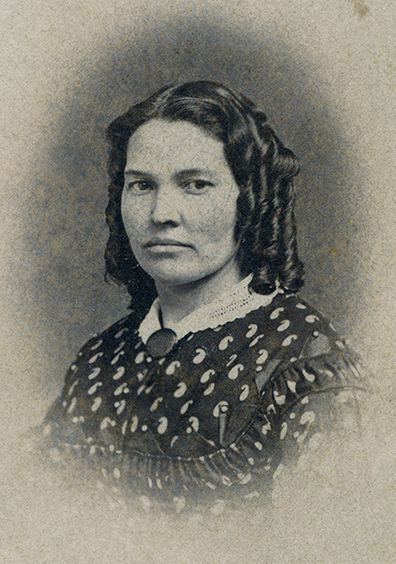
HANNAH KEZIAH CLAPP
At A Glance:
Born: 1824, Albany, New York
Died: 1908, Palo Alto, California
Race/Nationality/Ethnic Background: Caucasian
Primary City and County of Residence and Work:
Carson City and Reno
Major Fields of Work: Educator and Librarian
Other Role Identities: Organized first private school in Nevada; first instructor and librarian at new University of Nevada; co-founder of Nevada’s first kindergarten; activist and feminist in education and women’s issues; co-founder of Reno’s Twentieth Century Club.
Hannah Keziah Clapp was born in up-state New York in 1824 and at the age of 25 began her teaching career in a private seminary in Michigan.(i) She soon became a principal of the Lansing Female Seminary, and later taught at Michigan Female College. Like many other Midwesterners, she answered the beckoning call of the American West and joined her brother’s family on a wagon train going to California. She was 35 years old when she passed through the Truckee Meadows on her way to a teaching position in Vacaville, near Sacramento. But within a year she returned to Nevada, where she spent the next 41 years. In 1860 she accompanied the Perkins family to Carson City, where there were no schools for the growing number of children in the capital of the Nevada Territory. Seeing the great need for a school, Hannah Clapp organized a private co-educational school, with the blessings of the Territorial Legislature and powerful supporters such as Governor James W. Nye and Comstock mining baron, and soon-to-be U.S. Senator, William M. Stewart. By the end of 1864, her Sierra Seminary was already very successful, and had been visited twice by Mark Twain, whose observations of her teaching methods and final examinations were grist for some scenes in Tom Sawyer.
After an expensive expansion financed by the new State Legislature in 1864, the Sierra Seminary needed additional professional staff. Hannah Clapp hired Miss Eliza C. Babcock, a Latin and English teacher from Maine, as her assistant principal. The relationship lasted 35 years, until Eliza’s death in 1899. They built a home together on the northwestern edge of Carson City, which had an extensive surrounding fence and a landscaped garden cared for by a hired gardener.
The two women made the Sierra Seminary one of Nevada’s most outstanding schools, graduating many students who went on to influential positions around the nascent state of Nevada, as well as to prominent universities around the country. Their investments in a number of mines, including the Belcher mine, helped fund many of their endeavors as well as long trips across the country. After a cross-county trip in 1876 to the kindergartens in the East, they returned home to Nevada determined to replicate the innovative program for six year olds. In 1877 they opened the first kindergarten in Nevada, in the basement of the Sierra Seminary in Carson City. In 1895, after they had moved to Reno, they persuaded the new Twentieth Century Club to organize the Reno Kindergarten Association. Reno’s first kindergarten soon opened, in the annex of the Bishop Whitaker’s School for Girls, on the site of today’s Whitaker Park. After Eliza’s death in 1899, Hannah raised funds to build a new home for the school, named the Babcock Memorial Kindergarten, at the corner of Fifth and Walnut Streets in Reno. The beautiful two-story brick school remained in service for many years.
One of the duo’s most famous business transactions was the construction of the iron fence around the Capital grounds in Carson City. Because of the unsightly muddy field in front of the Capital, which attracted stray cows, loafers, and garbage, the 1875 Legislature set aside funds for landscaping, driveways, pipes for fountains, and a fence with a stone work foundation and iron railing. The bid was submitted under the name “H. K. Clapp of Carson City.” It was the lowest bid for the fence by $350. After they won the contract, Hannah and Eliza ordered the wrought iron from Philadelphia. After it was delivered and erected by local workers, they pocketed a $1,000 profit, to the amazement of many who must have doubted the power of the two business-wise women. The Carson City newspaper applauded the lucrative business deal, in a May 1875 article:
“Let there by no further complaints about the non-enjoyment of their rights by the women of Nevada. The contract for the furnishing of iron fencing for the Capitol Square has been awarded to Misses Clapp and Babcock, Principals of Sierra Seminary; their bid of $5,500 in coin for the delivery of the fencing upon the grounds is the lowest by some hundreds of dollars of those submitted.”(ii)
Despite these facts, a colorful legend circulated around the state for many years, which argues that “no one knew that the bidders were women,” and that they toiled under the hot summer sun, dressed in long woolen skirts, as they “built the fence themselves.” The myth persisted until 1996, when Guy Rocha and Dennis Myers put it to rest in their “Historical Myth a Month” series, which tells the true story.(iii)
When the new University of Nevada was moved from Elko to Reno in 1887, President Leroy Brown hired Hannah Clapp as the University’s first staff member, to teach history and English, in addition to overseeing the University Library in newly-constructed Morrill Hall. Because there was no electricity or gas in the campus’ first building when classes began, as she later recalled, they literally “burned the midnight oil” in the rooms to make the “blackness more palatable.”(iv)
Despite her boundless energy and devotion to the nascent University, she ran afoul of a new president who replaced her with a Harvard University graduate, in an attempt to upgrade the academic qualifications of the professors. Some had criticized her appointment in 1887, citing her “lack of education, age, etc.” and notwithstanding her friendship with the powerful Senator William Stewart, she never again felt at ease on the campus. Meanwhile, Eliza became seriously ill, putting a further strain on Hannah, who transported her to the care of doctors in San Francisco. Hannah worked hard to improve the University library, which was the safest assignment under the circumstances. By the time she retired at the age of 77 in 1901, the library had 6,000 books and 5,000 pamphlets.
When her life-long companion Eliza died in 1899, Hannah was profoundly distressed. Shortly thereafter she requested a leave of absence from the University. She was 77 years old by then, and decided to return to California after 41 years in Nevada. She moved to Palo Alto, to the home where she and Eliza had planned to retire. She passed away in Palo Alto in 1908, at the age of 84.
Hannah Clapp is remembered today as one of Carson City’s most interesting figures, but she also was the co-founder of Reno’s first kindergarten, and, being an ardent feminist and suffragette, was one of the founders of the Twentieth Century Club, a progressive women’s organization that planted the trees along Riverside Drive and worked to make Reno a safer and cleaner city (among their accomplishments: outlawing spitting in the streets).
Today, Hannah Clapp’s efforts are memorialized by the annual Hannah Humanitarian Award presented by the Committee to Aid Abused Women to a deserving citizen.
i. “Hannah Keziah Clapp: The Life and Career of a Pioneer Nevada Educator, 1824-1908,” Kathryn Dunn Totton, Nevada Historical Quarterly, Vol. XX, No. 3, Fall 1977, pp. 167-183.ii. Ibid., pg. 171.
iii. “Hannah Clapp and The Capitol Fence,” Historical Myth a Month, Guy Rocha, Nevada State Archivist, and Dennis Myers, Journalist, 1996;
iv. Totton, p. 173
Researched and written by Holly Walton-Buchanan, November 2008.
Sources of Information:
- “Hannah Keziah Clapp: The Life and Career of a Pioneer Nevada Educator, 1824-1908,” Kathryn Dunn Totton, Nevada Historical Quarterly, Vol. XX, No. 3, Fall 1977, pp. 167-183.
- “Hannah Clapp and The Capitol Fence,” Historical Myth a Month, Guy Rocha, Nevada State Archivist, and Dennis Myers, Journalist, 1996;
- “Hannah Clapp,” Carson City Visitors Bureau, retrieved from www.visitcarsoncity.com/history/people/hannah_clapp.php
- “Hannah Keziah Clapp,” Portraits of Nevada, Virginia Vogel, University of Nevada, Reno, retrieved from www.unr.edu/sb204/theatre/clapp1.html
- H. K. Clapp: Miss Clapp’s School,” Portraits of Nevada, Virginia Vogel, University of Nevada, Reno, retrieved from www.unr.edu/sb204/theatre/clapp1.html
- H. K. Clapp: Philanthropy,” Portraits of Nevada, Virginia Vogel, University of Nevada, Reno, retrieved from www.unr.edu/sb204/theatre/clapp1.html
- H. K. Clapp: Higher Education,” Portraits of Nevada, Virginia Vogel, University of Nevada, Reno, retrieved from www.unr.edu/sb204/theatre/clapp1.html
- H. K. Clapp: Works Cited,” Portraits of Nevada, Virginia Vogel, University of Nevada, Reno, retrieved from www.unr.edu/sb204/theatre/clapp1.html
- High Sierra Education,” Mary M. Baldasano, Las Vegas Hollywood” The Magazine for and about the Most Exciting Cities on Earth…Las Vegas and Hollywood, retrieved from www.lasvegan.net/Ivn_issues/14-jurassic/HighSierra.htm
- Hannah Humanitarian Award Winners,” Northern Nevada Laborers – Associated General Contractors Training Fund, from the Committee to Aid Abused Women Hannah Awards Program, 2/29/2000, retrieved from www.nevadalabor.com/unews/serving.html