
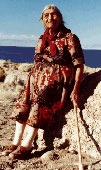
KATIE CHRISTY FRAZIER
The information below has been compiled from a variety of sources. If the reader has access to information that can be documented and that will correct or add to this woman’s biographical information, please contact the Nevada Women’s History Project.
At A Glance:
Born: about 1891
Died: August 5, 1991
Maiden Name: Christy
Race/Nationality/Ethnic Background: Native American, Northern Paiute
Married: John Hicks (divorced), Harrison Frazier
Children: Three children with John Hicks, Four children with Harrison Frazier
Primary City and County of Residence and Work:
Washoe, Pyramid Lake Indian Reservation
Major Fields of Work: Preserving and teaching Paiute traditions and customs
Other Role Identities: Wife, Mother, Grandmother, Educator, Folk artist, Quilter, Dancer
Around 1891 when Katie Christy was born, Indian births were not yet officially recorded. The time was still early in the settling of northwestern Nevada by the white man. Katie’s grandmother had grown up in the old ways, when The People (Nimi) were free to go about in their own land as they pleased. Katie was close to her grandmother, as was the custom, and they slept together under a rabbit skin blanket. For many years, Katie spoke only her native language, Northern Paiute. Because she had been born prematurely, she was small for her age and was called Titzipoona, which meant small and very lively.
Like many other Native Americans at that time, her mother and grandmother worked for white settlers to supplement the dwindling supply of wild foods available to them. Yet, the family preferred to follow the old ways when they could and in the summer they might be found encamped with relatives near the shore of Pyramid Lake, or digging camus (yapa) on the Madeline Plains to the north. In the fall, they traveled north to the Pine Nut Range for the pine nut harvest. Winters were spent in Honey Lake Valley where acorns, game, and wood for fires were abundant, and ranch work could be obtained. Their winter home was of the same efficient construction that had been in use for thousands of years, the conical willow house (kani) built anew each year by Katie’s mother.
By 1900 the population of white settlers in Nevada had exploded, and the Northern Paiutes who survived the years of deprivations and diseases, had been pushed onto reservations. Titzipoona had been given another name, one that could be written in English, Katie Christy, and she was required by state law to go to a military-style boarding school for Indian children. Established by the Nevada State Legislature in 1887, Carson Indian school (later renamed Stewart Indian School), operated under a federal policy to acculturate and educate Indian children to the ways of the white world. Her mother estimated that Katie was about eight years old when, in 1900, she took her to Carson and left her.
Following her graduation in 1908, Katie married John Hicks and they had three children. She worked for white families in Virginia City and Reno; in 1918, John Hicks enlisted in WWI. Their marriage ended after the long separation caused by the war, and in 1921 Katie moved to the Pyramid Lake Paiute Reservation. She later married her second husband, Harrison Frazier, and they had four children.
Katie was an enthusiastic advocate for the traditional Indian ways, not only because she enjoyed them, but because it was important to her that knowledge of the Northern Paiute culture be passed on. In 1989, she said this about dancing:
“I just love to dance! I’d be dancing yet today if I could. Us Indians used to have lots of dances here at Pyramid Lake. A long time ago, people would come from all around and make a big camp by the Truckee River where Wadsworth is now, and they would circle dance a whole week. People did this in the fall, before they went to the mountains to pick pine nuts. They were dancing for a good harvest. Pine nuts meant a lot to us because it was our winter food. I was little then, but I remember how the dance kept going, night and day. Some dancers would go off to rest, but the dance kept going. Us children would always run and play. Sometimes we’d get into mischief! In the winter, people would come to fish along the river where it goes into the lake, and they danced then too. Later some of us here at Pyramid Lake formed a dancing group. We danced at pageants and ceremonies, hospitals and schools, wherever we were invited. My husband was the singer. We did the Antelope Dance, the Owl Dance, the Bear Dance, lots of dances” (Peden).
Katie Frazier’s life is a fascinating saga of survival during a period of rapid and drastic change. Whether tanning deer hide to make cradle boards and moccasins, or teaching dances, songs and the Paiute language to schoolchildren at Pyramid Lake, Katie embodied strength, practicality and wisdom. Those who knew her remember another quality that was delightful: her droll sense of humor and her wit.
On August 5, 1991, Katie spent most of the day stitching together squares of cloth, making another of her beautiful patchwork quilts. She had recently celebrated her 100th birthday, and both Nevada Senator Richard Bryan and President George Bush had sent engraved cards of congratulations. She joked, “Well, I’m glad they know how old I am, and I might be older though.” At that advanced age, her health was still good: she read, sewed, and loved to go places. In July she had gone with the family to Fallon to spend the day at the All-Indian Rodeo. And so, on August 5th, a Tuesday, when the time came that Katie was called Home, she went easily and gently, smiling.
Katie Frazier, a member of the Pyramid Lake Paiute Tribe, was widely known throughout Nevada. She received many awards in recognition of her work, among them National Indian Educator of the Year, 1985; the Governor’s Award for Excellence in Folk Arts, 1986; and Outstanding Senior Citizen of the Year, 1989.
Biographical sketch by JoAnne Peden, February 2, 1998; edited by Janet E. White 1/2001.
Works Cited:
- Frazier, Katie. Video tape. That Was Happy Life: A Paiute Woman Remembers*
- Macias, Sandra. Interview with Katie Frazier. Reno-Gazette Journal, February 9, 1986. (A michrofiche copy may be viewed at Washoe County Library).
- Peden, JoAnne, a friend of Katie Frazer.
-
*This award-winning video may be purchased by mail from the University of Nevada, Reno Teaching and Learning Technologies, (775) 784-6085. It is also available at: Pyramid Lake Visitor Center, Sutcliff, Nevada; I-80 Smoke Shop, Wadsworth, Nevada; Sundance Bookstore, Reno, and at museum gift shops throughout Nevada. (All proceeds from the sales of Katie’s video are applied to the Katie Frazier/Native American Alumni Chapter Scholarship for Nevada Indian students at UNR.)