
University of Nevada Reno
Oral History Program
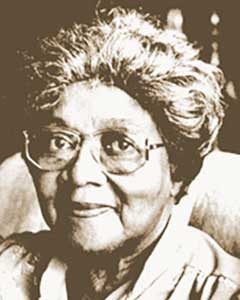
LUBERTHA MILLER JOHNSON
The information below has been compiled from a variety of sources. If the reader has access to information that can be documented and that will correct or add to this woman’s biographical information, please contact the Nevada Women’s History Project.
At A Glance:
Born: 1906 (exact date unknown)
Died: February 6, 1989
Maiden Name: Miller
Race/Nationality/Ethnic Background: African American
Married: Lawrence Warden
Primary City and County of Residence and Work:
Las Vegas (Clark)
Major Fields of Work: Medicine (nurse), Social welfare (poverty program administrator), Civil rights (NAACP)
Other Role Identities: Wife, Mother, Farmer Worker, Recreation Director, Civic Leader
Journey from the rural South to Las Vegas community activism
Lubertha Johnson was born in Ackerman, Mississippi, in 1906 to Golden and Mary Miller. She was born on a farm that her father had inherited from his father Joe, who had been a slave.
During many of her early years, Lubertha lived with her grandmother about ten miles from the Millers. This grandmother, whose father had been murdered by white bigots, enjoyed having her granddaughter live with her while Lubertha’s parents worked hard to get ahead–it was also easier for Lubertha to attend school from her grandmother’s place. From her grandmother, Lubertha learned many skills, such as how to use a spinning wheel and how to use various plants to dye cloth different colors. On the farm, the two women raised rice, corn, and a small amount of cotton; they also tended a large orchard.
The Millers were working hard in the South at a time when the KKK membership was growing by leaps and bounds (the 1920s), and the family subsequently made the decision to move north to Chicago. They decided to travel by train, but the station master for the railroad in Lubertha’s town would not sell them tickets; friends took them by wagon to another town from which the family left.
The move to the Chicago area opened up a whole new world to Lubertha as she became exposed to a metropolitan area with its tall buildings and a more sophisticated lifestyle. Seventeen years old when she arrived in Chicago, Johnson landed in a neighborhood which was mostly Italian. This was her first interaction with whites. At home in the South, blacks and whites did not mingle. A year later, the family moved to another suburban area, Maywood, a steel mill town where her father worked.
Johnson found race relations in the North much better than in the South, but she refused to go to school with white children at first. Finally, she agreed, and enrolled at Chicago Music College and the Y College, where she met not only white people from her area, but white people from the South who wanted to be friendly. This also was a new experience for her. Following high school, she enrolled in Roger Williams University, an all-black school, in Nashville, Tennessee. She planned to pursue a teaching career but the Depression of the 1930s forced her to quit school and get a job to help support her family. She remained in the Chicago area when her parents moved to Pasadena for Mr. Miller’s health.
In 1943, Lubertha moved west to be with her parents and immediately got a job in public housing for the Urban League. She remained there only a few months before moving to Las Vegas where the family purchased a twenty four acre ranch in Paradise Valley on which they raised chickens. It was located near Eastern Avenue and Sunset Road. Many blacks found the ranch to be a favorite picnic and recreation spot as they were then barred from mainstream accommodations. The ranch was sold in 1979.
Lubertha worked as recreation director of the Carver Park Housng Project in Henderson. She served as president of the local NAACP chapter and was a signee of the Consent Decree to end employment discrimination in the hotel and casino industry. She was a member of Gamma Phi Delta Soroity, The National Conference (formerly the National Conference of Christians and Jews), a board member of the Caliente School for Girls and founder of Operation Independence Pre-school Learning Center.
Ms. Johnson was sometimes compared to the famous educator, Mary McLeod Bethune, in that she had access to powerbrokers and often used that to push for social change. During her lifetime Lubertha Johnson was a recipient of numerous awards in recognition of her contributions to the community and to the State of Nevada. She left a legacy for all: “Education is the key to independence.” She was Southern Nevada’s first black nurse, but it is felt that she really made her mark after becoming active with the NAACP’s Las Vegas chapter in 1945. Her work there included two different terms as president of the organization. Her many accomplishments included helping to expand employment opportunities for blacks in the school district, hospitals and hotels. She is also credited with helping to enact open housing legislation and helping in the fight to enact Nevada’s civil rights law.
One of her proudest achievements was the founding of the county’s first anti-poverty, self-help initiative, Operation Independence. It included the first Head Start program, the Manpower program, and the Operation Independence child development centers and was the first black nonprofit agency to receive funding from the United Way of Southern Nevada.
On February 6, 1989, Lubertha died in a Las Vegas nursing home.
Biographical sketch by Sally Wilkins and Jean Ford
Published Works:
- Johnson, Lubertha, Lubertha Johnson: Civil rights efforts in Las Vegas, 1940s-1960s, an oral interview conducted by Jaime Coughtry. Reno: Oral History Program, University of Nevada, 1988.
Sources of Information:
- Burkhart, Joan, “Las Vegan recalls role in local civil rights efforts.” Las Vegas Review Journal, February 9, 1989.
- Knight, Sarann. “The Lubertha M. Johnson Story. Alpha Rho Chapter, Gamma Phi Delta Sorority, Inc. Papers. November 1978.
- McClure, Florence. “A Time to Weep…But Also Rejoice.” Mentor. February 1996.