

The information below has been compiled from a variety of sources. If the reader has access to information that can be documented and that will correct or add to this woman’s biographical information, please contact the Nevada Women’s History Project.
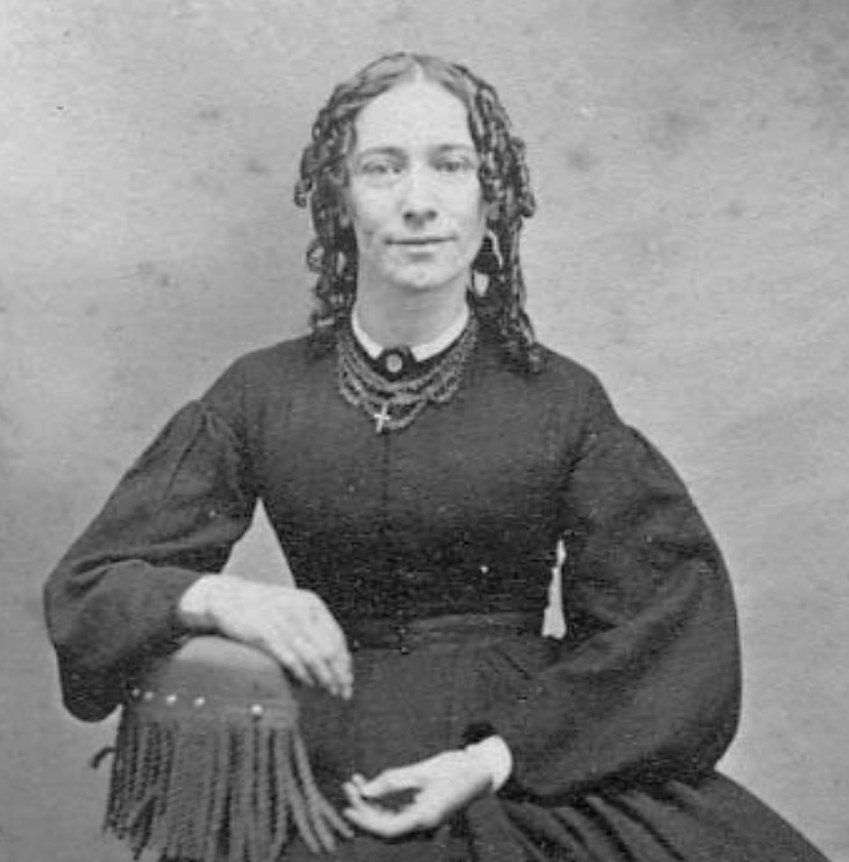
Ancestry.com
At A Glance:
Birth: 1836 in Livingston County, New York
Death: May 15, 1903, Potter Valley, Mendocino County, California
Maiden Name: Mary Matilda McNair
Race/nationality/ethnic background: White, Irish
Marriage: Cortright Mathews, (or Aaron Kortright), December 24, 1855
Children: Charles W. Mathews, born December 14, 1859
Primary city and county of residence and work: Virginia City, Storey County
Major fields of work: Seamstress, writer
Other role identities: Owner of mine shares, mother, chronicler of Virgina City
Virginia City transplant chronicled late 1800s Comstock life
A native of the Eastern United States, Mary McNair Mathews was forced to travel to Virginia City during the Comstock Lode era to deal with her brother’s murder there. She worked hard at many “female” occupations to make a living for herself and her son. She wrote of her struggles and experiences and her love for the Nevada mining town that reveal valuable historic details of domestic and social life.
Mary Matilda McNair was born in 1836 in Livingston County, New York, to Charles Williamson McNair and Mary Avery Tozer McNair. Her siblings included older siblings Maryann, Miles, Caroline, Hugh and Sarah. After Mary came Henrietta, Charles, John, and Henri, making 10 children in total and a 24-year age difference between the oldest and youngest. In 1845 her youngest brothers, John and Henri, passed away, only 9 and 7 years old, blanketing the entire family with grief.
Mary sometimes went by her middle name, Matilda. A Matilda M. McNair shows up in the Oberlin College registry, with her sister Sarah McNair right underneath. Mary attended Oberlin from 1853 to 1857 and came back to her family in New York afterward. On December 24, 1955, while at Oberlin, Mary married Aaron Kortright Mathews (sometimes spelled Courtwright, or variations), typically calling him Kortright. On their wedding day, she was 21 years old and he was 34.
Mary got pregnant in 1859 and gave birth to a boy, Charles Williamson Mathews, on December 14, 1859. She named him after her youngest living brother, Charles Williamson McNair. By 1865, Mary and her son were living with Mary’s family, the McNairs, but not with Courtwright, implying he had died sometime between 1860 and 1865.
The year 1865 was a significant year for Mary for other reasons: her beloved brother Charles had been killed in Gold Hill in the far-off infant state of Nevada, at the age of 24. The McNairs got a letter from an acquaintance in American Flat, Nevada, announcing the news. Charles had apparently been shot by a shotgun, after confronting a Secessionist to leave a garden at his workplace. Charles also apparently owned mining property, mining stock and a millsite.
Mary knew she had to go to sort out both Charles’s finances and investigate his death. Widowed with a son and earning a comfortable income from a hoop-skirt factory, she was able to sell her company and uproot her life for her family. On August 11, 1869, Mary and Charley left New York for Virginia City, Nevada, traversing the country by train. The trip was stressful, and Mary was quickly using up her savings.
By August 30, she had made it to the Comstock, a place very different from her home on the East Coast. The mining town didn’t accept script paper as currency, and food, services and housing were all shockingly expensive from a higher cost of living. Mary kept her East-Coast attitude about not taking help when offered, which went against the gracious and charitable Virginia City. She was proud to take only things she earned, even if it offended whoever was offering.
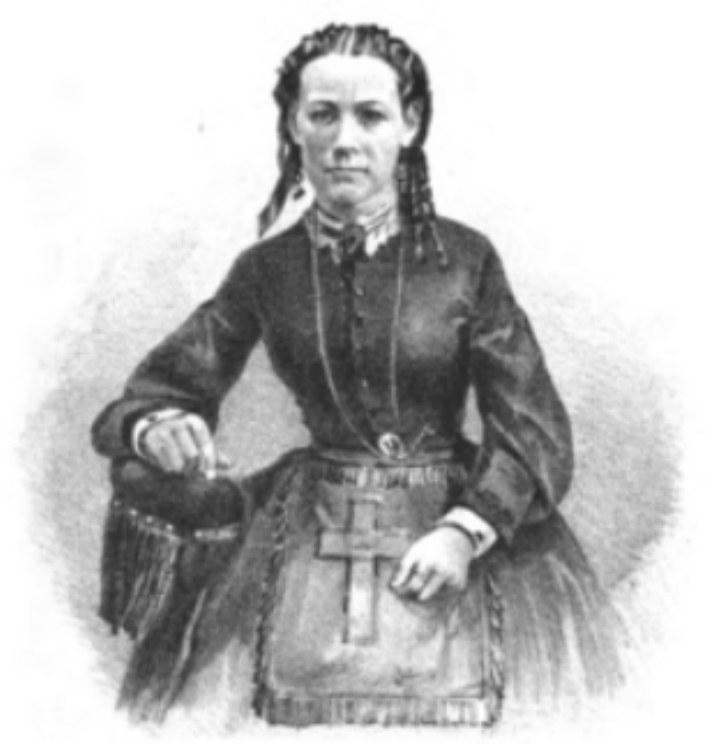
Wikipedia, 1880
While in Virginia City, Mary kept income coming in through many different ventures: sewing, teaching, nursing the sick, housekeeping, boarding, and inheriting Charles’ claims and property. As a woman and a widow, Mary could only make money in ways that met the gender expectations of the time. Although Mary recounts her time in Virginia City with many money struggles, she was able to survive through these jobs, even if inconsistently.
Her book Ten Years in Nevada was incredibly important to Virginia City history, as it gave close details on everyday life in Virginia City. Mary detailed specific characters, including John Mackay and Judge Noyes, as well as information around specific neighborhoods in the city, social events and benefits, societies and lodges, and specifics of living usually lost in time. With her recounts, she also conveys opinions and stereotypes that were more acceptable at the time, against lawyers, men, miners, and especially against racial minorities. Although flawed, these opinions also served as representations of cultural opinion and a very small insight into how these minorities lived, even if masked under a heavy layer of prejudice. So many documents about Virginia City have been lost, and even fewer of those still accessible give such a thorough description of the city’s intricacies, so Mary’s book serves as one of the only female, personal documents from the time.
By 1877, her son Charley had become a young man, independent enough to head to San Francisco to rest from typhus fever, which was spreading through Virginia City. After his health improved, he found a job at the California Theater as an actor. But he again got sick, and Mary was called to help nurse him. She arranged for her house and small store to be rented and her other affairs to be taken care of.
After Charley again got well, Mary felt the call to head back home to the East Coast. On top of the frequent sicknesses in the city, Virginia City had gone into an economic decline, as the Comstock was producing far less ore. By the end of 1877, they were happily back in New York. But the Comstock continued to decline, and Mary’s investments in Virginia City slowed, and then stopped. Mary took the journey back to Virginia City one more time in late 1878, to sell off her remaining stock and her house. She lost money on all but knew she would not be coming back to Virginia City after this.
But that would not be her last time on the Pacific Coast: her son Charley would move back to California by 1891, in the Ukiah area of Mendocino County. Mary then moved to be with him and lived with him until her death in 1903, at the age of 61. Charley was very close to his mother and nursed her until her death.
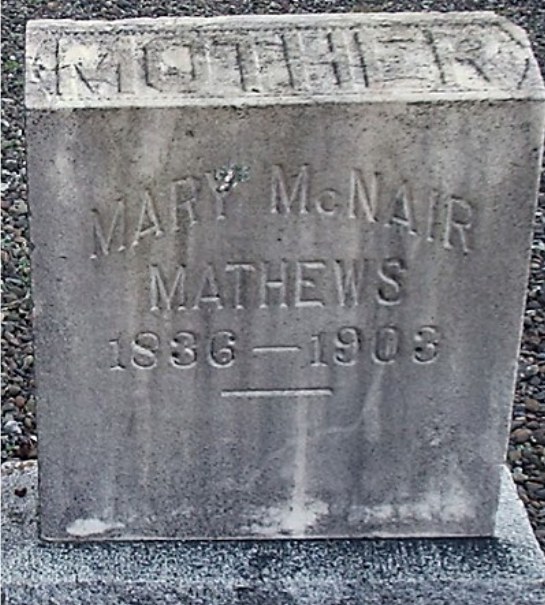
Mary McNair Mathews is buried in the Ukiah Cemetery, Ukiah, Mendocino County, California, near her son Charles.
Although controversial in her musings and opinions, Mary McNair Mathews has become an essential voice in Nevada history, speaking about the Comstock during its most important years. Her love for the area was obvious, although complicated. At the end of her book, Mary concluded with, “But, reader, after all I have suffered in the land of sage, I would much rather live there than in the East. […] My health was much better there, […] if I dealt with a person, I knew what to expect…” and “if I transact my own business, I can make more money in three months than I can in the East for a year.” Her life in Nevada made her more independent, part of the important social life of Virginia City, and kinder in some ways. She will forever be identified by her representation of domestic life on the Comstock.
Published Work:
1880 Ten Years in Nevada: Life on the Pacific Coast. Buffalo: Baker, Jones, & Co. Printers and Binders.
Researched by Patti Bernard and written by Aubrey Garrard, 2026. Posted November 2026.
Sources of Information:
“A Literary Curiosity.” Daily Territorial Enterprise (Virginia City, Nevada), 3 July 1881, p.3.
Ancestry.com. Nevada, U.S., Compiled Census Index, 1860-1910 [database on-line]. Lehi, UT, USA: Ancestry.com Operations Inc, 1999. [1870, Mary Mathews]
Ancestry.com. New York, U.S., State Census, 1865 [database on-line]. Lehi, UT, USA: Ancestry.com Operations, Inc., 2014. [Mary M Matthews]
Ancestry.com. Residence Date: 1850; Home in 1850: Portage, Livingston, New York; Roll: 524; Page: 124a. [Mary McNair]
Ancestry.com. Residence Date: 1860; Home in 1860: Veteran, Chemung, New York; Roll: M653_730; Page: 986; Family History Library Film: 803730. [Matilda M Mathews]
Ancestry.com. U.S., Find a Grave® Index, 1600s-Current [database on-line]. Lehi, UT, USA: Ancestry.com Operations, Inc., 2012. [Mary Matilda Mathews]
Ancestry.com. Year: 1870; Census Place: Virginia City, Storey, Nevada; Roll: M593_835; Page: 443A. [Mary Mathews]
Amcestry.com. Year: 1880; Census Place: Portage, Livingston, New York; Roll: 859; Page: 366a; Enumeration District: 037. [Matilda Mathews]
Ancestry.com. Year: 1900; Census Place: Potter Valley, Mendocino, California; Roll: 93; Page: 7; Enumeration District: 0073. [Mary M Mathews]
California State Library; Sacramento, California; Great Registers, 1866-1898; Collection Number: 4-2A; CSL Roll Number: 25; FHL Roll Number: 976936 [Charles Williamson Mathews]
James Fitch, “Catalogue of the Officers and Students of Oberlin College for the College Year 1853-1854.” Oberlin, 1854, p.29. https://ia601604.us.archive.org/20/items/annualcatalogueo18501862ober/annualcatalogueo18501862ober.pdf
McNair Mathews, Mary. Ten Years in Nevada: Life on the Pacific Coast. Buffalo: Baker, Jones, & Co. Printers and Binders, 1880.
“Remembering Mary Matilda Matthews [sic], A Pioneer Woman in the 1870’s.” American Heritage Partners. https://americanheritagepartners.net/2026/05/15/remembering-mary-matilda-matthews-a-pioneer-woman-in-the-1870s/
Watson, Anita. “Mary McNair Mathews.” Online Nevada Encyclopedia, March 11, 2011, http://www.onv-dev.duffion.com/articles/mary-mcnair-mathews