
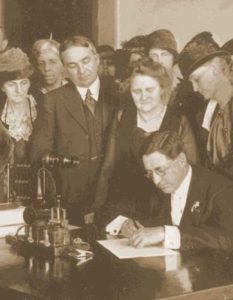
Feb 7, 1920. Assemblywoman Sadie Hurst is beside the Governor.
SADIE DOTSON HURST
The information below has been compiled from a variety of sources. If the reader has access to information that can be documented and that will correct or add to this woman’s biographical information, please contact the Nevada Women’s History Project.
At A Glance:
Born: July 27, 1857
Died: January 27, 1952
Maiden Name: Dotson
Race/Nationality/Ethnic Background: Caucasian
Married: Horton Hurst
Children: Two sons
Primary City and County of Residence and Work:
Reno (Washoe)
Major Fields of Work: Government (elected member, Nevada Assembly), Politics (suffrage leader)
Other Role Identities: Wife, Mother, Clubwoman
First Nevada woman legislator presided in 1920 Assembly suffrage resolution
On July 27, 1857, a daughter, Sadie, was born to Charles A. and Miriam Dotson in Iowa. Whether Sadie was an only child or one of many is unknown. Also unknown are any facts about her childhood. We do know that at some point she grew up, married Horton Hurst and continued to live in Iowa. At the age of twenty-eight, Sadie gave birth to her first son, Glenn, and two years later to her second son, Dale. When her husband passed away (year unknown), Sadie continued to live in Iowa with Glenn and Dale who had developed an interest in theatrical enterprises. It appears that it was those interests which brought them to Reno in the early 1900s.
Sadie was an extremely busy “clubwoman.” She served as president of the Washoe County Equal Franchise Society in 1914, and proved to be an active force in founding new societies in Sparks, Verdi and Wadsworth.
In April 1916, the Sparks Tribune refers to a meeting held at the home of Sadie D. Hurst, president of the Women’s Citizen Club. It was an informal meeting with Miss Elizabeth Hauser and Miss Walker who were representing Mrs. Carrie Chapman Catt, president of the National Women’s Suffrage Association. They spoke on non-partisan methods of the National Society and on the great progress of equal suffrage throughout the world.
In October of 1916 Sadie joined the newly organized Women’s Republican Committee of Washoe County. That same month, Sadie was elected to be one of the alternate delegates that the Twentieth Century Club was sending to the annual meeting of the Nevada Federation of Women’s Clubs in Goldfield, Nevada.
On Sadie’s 61st birthday, the Reno Evening Gazette ran an article saying that Mrs. Sadie Hurst, a 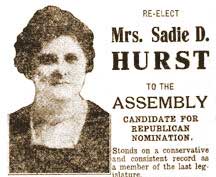 prominent club leader, had not fully decided yet whether to make the race for assembly or not, but that she was giving it a serious consideration. Mrs. Hurst was quoted as saying “I have been urged by a number of my friends and club workers to become a candidate, but I have not fully decided as yet. I expect to have an announcement to make early next week.”
She did decide to run for the Assembly as a Washoe County candidate and the next information was a public endorsement for Mrs. Hurst. The resolution by the Women’s Citizen Club read as follows: “Whereas, Mrs. Hurst has always given strong adherence to all moral issues and has a broad knowledge of the state’s needs as a successful club leader, we, the members of the Women’s Citizen Club, hereby endorse her candidacy for the Assembly and recommend her to the voters of Washoe County as worthy of the most able support.”
The press wrote little about Mrs. Hurst, nor did she campaign very much. Her announcement read that she was endorsed by the Club Women of Reno. Also a second campaign flyer read “Not a member of the Woman’s Party,” disclaiming association with the more militant suffragists such as Anne Martin.
On Election Day, 1918, Mrs. Sadie D. Hurst became the first female legislator in Nevada. Early in December, Mrs. Hurst gave a newspaper interview stating: “I am pledged to but one thing and that is to vote for the ratification of the federal prohibition amendment. I shall be deeply interested in and stand for all legislation that appeals to me to be for the best good of the state. I expect to be quite conservative in my views and certainly have no desire or intention to revolutionize the affairs of the state”.
She also stated that she expected to give particular attention to legislation designed to benefit women and children. She knew that the Federation of Women’s Clubs were working on a legislative program and in all probability, she would introduce some of the measures that they agreed upon.
In January of 1919, Sadie D. Hurst took her place with the other assemblyman and was sworn into office. Apparently much discussion went on in the Assembly as how to address the Honorable Sadie Hurst. Some call her the “Assembly Woman,” while others saluted her as the “Gentle Lady.” The Washoe delegates were very proud of having a woman delegate.
The editor of the Carson City Daily Appeal chose to ignore the fact that there was a female in the legislature and saluted “A Splendid Appearing Body of Men.” It is unknown what Mrs. Hurst’s response was to this obvious oversight.
Sadie was appointed to four committees: Education, State Institutions, Federal Relations and State Prison and Insane Asylum. Shortly after the beginning of the session, it was determined that the latter committee was overpopulated and Mrs. Hurst and Mr. Richards were removed from that committee.
An interesting note to that removal is that in 1981, Assemblywoman Louise Aloys Smith told a reporter that her membership on the committee responsible for the State Prisons and Mental Institutions was prohibited. She explained that the men wouldn’t allow it. The said it wasn’t a place for a lady. No woman ever did serve on that committee during those years.
True to her word, Mrs. Hurst set out to do just what she said she would. She introduced eight bills into the Assembly.
On January 23, 1919, Mrs. Hurst introduced AJ/CR 2 which was the resolution amending the Constitution of the United States, granting the right of suffrage to women. The resolution was adopted.
On January 26, 1919 the Nevada State Journal stated that the woman member, Mrs. Hurst, had already had the pleasure of seeing some of her legislative propositions take the form of law. They said that the most important legislation passed during the week was the ratification of prohibition amendment, the creation of the legislative fund, the payment for the state printers, Mack’s red flag bill and Mrs. Hurst’s petition to Congress for woman’s suffrage.
Sadie must have been feeling very good about her accomplishments the first week of session.
Other bills she introduced were AB 25, a bill for the registration and licensing of graduate nurses. This bill was passed, vetoed and sustained. It was vetoed because it did not specify standards, but in an article in the Carson City Appeal on February 6, 1920, Governor Boyle stated that this bill was vetoed at the request of the nurses who did not like it.
- AB 8 was an act relating to the guardianship of the person and estates of a minor child or children of a deceased father. This was tabled in the Assembly.
- AB 39 required the wife’s consent to the disposal of community property. This bill passed the Assembly and was then sent to the Senate where it was tabled.
- AB 59 declared all persons, whether male or female, of the age of twenty-one years, who are under no legal disability, to be capable of entering into any contract, and were, to all intent purposes, held and considered to be of lawful age. This bill was tabled in the Assembly.
- AB 94 (Chapter 178) was an act for the prevention of cruelty to animals defining certain terms and fixing the grade of crimes for violation thereof. This bill passed.
Assemblywoman Hurst held sincere convictions in her desire to protect helpless beasts. Some legislators arranged a street fight between a badger and a bulldog. Outraged, Hurst rose on the floor of the Assembly to protest this brutal plan. Speaker Fitzgerald humorously appointed himself a committee of one to investigate and report to the “lady from Washoe.” One version of the story declares that the Speaker displayed the “Badger” and revealed that it was a chamber pot. Needless to say, Sadie was the butt of a joke by some of her fellow legislators. Because of this incident, she became known as “one of the humane members of the lower house.”
- AB 182 was an act creating a State Board of Charities and Corrections, defining their power and duties and other matters properly connected therewith. Passed committee. Not voted on.
- AB 271 (Chapter 234) referred to the crime of rape and raised the age of consent of females to age of eighteen. The bill passed. An attempt to raise the age of consent from sixteen to eighteen had been presented at the four previous sessions and had been tabled each time. That age of consent still stands today.
One of the bills brought before the 1919 Legislature would grant the right of marriage between Caucasians and Indians. Mrs. Hurst, according to the Reno Evening Gazette, was the chief opponent of the measure. She was quoted as saying “I do not believe in the intermingling of races.” The measure passed and became a law.
Two different articles stated that Mrs. Hurst was excluded from some “all men” functions. The first one appeared in the Nevada State Journal on January 26, 1919. Apparently Governor Boyle was to entertain the members of both houses at the mansion for dinner. The article stated that the ladies would not be present at this gathering. I am assuming that Mrs. Hurst was excluded. The other was near the end of the session when the Journal of the Assembly included this brief put pointed statement: “Mr. Speaker read a communication from the War Department extending an invitation to the male members of the Assembly and Senate to attend a moving picture and lecture at the Grand Theater.” Mrs Hurst’s response to this omission was not known.
The outcome of Mrs. Hurst’s term in the Legislature was very good considering her novice status. Her bills received a somewhat better fate than those of many other freshman legislators.
According to the Reno Evening Gazette, the Parent-Teacher Association honored Sadie by presenting her with a handsome gold mounted umbrella as a present in appreciation for her work as a member of the Assembly.
Not much was written after the session about Mrs. Hurst until the Special Session which was called in February of 1920 to ratify the Federal Suffrage Amendment.
The women’s clubs wanted to be assured a quorum so this important issue could be ratified by Nevada. The groups got busy and sent letters to all the legislators requesting their attendance at a special session, which would be called by Governor Boyle. The Washoe delegation was even invited to ride a special train due to the poor condition of the road to Carson City. This train car was added to the regular Virginia & Truckee train. Approximately fifty men and women rode this train to Carson City. The women were extremely excited and put a banner on the side of the train calling it the “Suffrage Special”. They attached the banner to the train with seventy-one tacks nailed into the side of the car. The banner made it to Carson City and was then removed by the conductor. He was upset that the women had defaced railroad property.
Speaker Fitzgerald called the special session of the house to order at 11:00 am. Due to the historical importance of the event and because Mrs. Sadie Hurst was the only women representative in the legislature, he asked her to preside over the Assembly during the passage of the resolution. Mrs. Hurst took the chair and put the question and announced the vote with as much decorum and familiarity with parliamentary usages as any of her male colleagues. The resolution passed the Assembly 25 to 1 with Assemblyman Ferguson of Eureka County being the only nay vote. The resolution passed the Senate with every member present voting in its favor.
After the voting had passed the house, Mrs. Hurst resumed her place on the floor and addressed the speaker, stating that a number of suffrage leaders were present and asked that they be permitted to speak on the subject just passed. Brief remarks were made by Mrs. F.G. Patrick, Mrs. J.E. Church, Mrs. R.D. Eichelberger, Mrs. Sam Belford, Mrs. W.H. Hood and Mrs. D.L. Gassoway, all of Reno. Sadie was front and center at the time Governor Boyle signed the resolution. What a joyous day that must have been.
It was noted in the Reno Evening Gazette on February 9, 1920 that the two gold pens which had been given to Governor Boyle to use in signing the resolution had been donated by the Nevada Federation of Women’s Clubs. One pen was then donated to Mrs. Carrie Chapman Catt and the other went to the Nevada Historical Society for preservation in the archives.
A ratification ceremony was held in August of 1920. Mrs Hurst was on the committee in charge of planning this event and spoke on the “Women’s Part in the Ratification.”
Sadie’s bid for reelection was not successful. She lost to Mr. Addenbrooke in September of 1920. The 1920 Census showed that Mrs. Sadie Hurst lived at 135 Mill St. in Reno. She lived with her son Dale. It also showed that Mr. Glenn Hurst and wife, Helen, had two children and that they lived at 238 Belmont Rd. in Reno. Mrs. Hurst’s granddaughter’s name was Harriett and her grandson’s name was Robert.
Glenn Hurst was an unsuccessful candidate for mayor of Reno in 1919. In the same year, he was made managing director of the Reno Rodeo.
Sadie remained active in club work and it was noted that she was in charge of the Information and Reciprocity Bureau of the State Federation of Women’s Clubs in October of 1921. She also gave an able address which showed intimate knowledge of the Nevada laws concerning women and children.
The Hurst family left Nevada about 1922 and moved to California where Glenn and Dale founded a silk manufacturing plant in 1923 in Escondido. Glenn died suddenly in 1940 at age 56.
Little is known about Sadie after she left Nevada. She passed away in Pasadena, Calif. on January 17, 1952 at the age of 94 from a hemorrhage caused by cancer of the uterus and is buried in Escondido’s Oak Hill Memorial Park.
Sadie Hurst opened a big door to women in Nevada politics. Since her session in the 1919 Legislature, there has only been three sessions – 1931, 1933, and 1947 – where a women did not serve. During the 1995 Session over one-third of the Legislature was female. Fourteen years later, in the 2019 session, Nevada broke records as the first state in the union to have a female majority legislature, with 33 women holding 50.8% of the state’s 63 legislative seats.
Biographical sketch by Tammy McMenomy
Published Works:
- Warren, Anna and Hurst, Sadie. Summary of Laws Concerning Women and Children. Nevada League of Women Voters. 1923.
Sources of Information:
- 1920 Census. Latter-Day Saints Family History Center, Reno, Nevada.
- American Mother’s Committee. Mothers of Achievement in American History, 1776-1976. Rutland, VT: CE Tuttle Co., 1976.
- Bennett, Dana R. “Leading Ladies.” Nevada Magazine, March/April, 1995.
- Bennett, Dana R. “Women in the Nevada Legislature.” Background Paper 95-1, Carson City: Legislative Counsel Bureau. 1995.
- Carson City Daily Appeal, February 6, 7, 1920.
- Elko Daily Free Press, December 11, 1918.
- Glass, Mary Ellen. “Nevada’s Lady Lawmakers: The First Half Century.” Nevada Public Affairs Review, Reno, October 1975.
- Nevada State Journal, October 10, 18, 1916; October 10, 1918; November 7, 1918; January 23, 26, 30, 31, 1919; August 29, 1920; September 5, 8, 9, 1920; October 22, 1921.
- Nevada State Legislature, Assembly Journals, 1919, 1920.
- Reno Evening Gazette, July 27, 1918; December 9, 1918; March 12, 19, 21, 1919; February 6, 9, 20, 1920.
- Sparks Tribune, April 4, 1916.
- “Hurst to Manage Reno’s Rodeo Celebration.” Reno Gazette-Journal (Reno, Nevada), May 24, 1919, p.6
- “Opportunity Seen in Territory for Development of Raw Silk Industry.” Honolulu Star Bulletin (Honolulu, Hawaii), Jan. 12, 1929, p.13.
- “Glenn Hurst Dies Suddenly.” Nevada State Journal (Reno, Nevada), April 18, 1940, p.2.
- Ancestry.com. U.S. Find a Grave Index, 1600s-Current, (Sarah Dotson Hurst).