
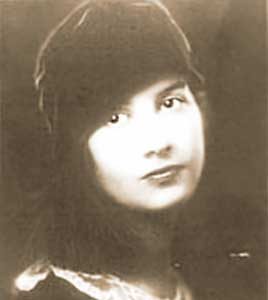
Courtesy Zanjani Collection
SALLIE MARIA RUPERTI SPRINGMEYER
The information below has been compiled from a variety of sources. If the reader has access to information that can be documented and that will correct or add to this woman’s biographical information, please contact the Nevada Women’s History Project.
At A Glance:
Born: August 22, 1903, New York City, N.Y.
Died: December 23, 2007, Indian Creek Ranch, Douglas County, Nevada
Maiden Name: Sallie Maria Ruperti
Race/Nationality/Ethnic Background: Father, German American, of a family known as the “merchant Princes of Hamburg”; mother of aristocratic British descent, tracing her lineage to Eleanor of Aquitaine.
Married: May 2, 1931 to George Springmeyer (2nd marriage)
Children: Sally Springmeyer (Zanjani)
Primary City and County of Residence and Work:
Reno, Washoe County and Minden/Gardnerville, Douglas County
Major Fields of Work: Attorney and Public service activist
Other Role Identities: Charity volunteer
In 1930 Sallie alit from a train in Reno seeking a divorce. She was met by the attorney her New York lawyer had engaged for her, George Springmeyer. Enchanted by her dark beauty, he took her dancing immediately, which she thought must be a strange custom of the West. Over the three month period then required to establish residence for a Nevada divorce, she became equally smitten with this man of sterling character, so different from the husband she was shedding. George, by contrast, had led an eventful life. He grew up on a pioneer ranch in the Carson Valley, received his law degree from Stanford, attended Harvard for post graduate work, joined the rush to the Goldfield mining boom, served as an Army captain in World War I, and became U.S. Attorney during the Prohibition era in the twenties. Difficult though it was to explain to her family why she would like to live in the place they envisaged as the exotic and somewhat dangerous West, Sallie and George were married in Ridgefield, Connecticut, on May 2, 1931.
He brought her back to the home he had bought for her on the outskirts of Reno, a white house with a red-tiled roof and acres of gardens and orchards set on a hill overlooking a vista of mountains and meadowlands. They named it Sage, SA for Sallie and GE for George. After the death of George’s father, Herman Henry, George inherited the Indian Creek Ranch in the hills southeast of the Carson Valley. George and Sallie went camping there under a juniper tree and decided they would develop the ranch. Henceforth their time was divided, weekdays spent in Reno, where George conducted his law practice, and weekends at the ranch.
Even after a small red brick ranch house replaced the juniper tree, life at the ranch was primitive in those days predating electricity. All the same, although Sallie had been raised on New York’s upper east side in a brownstone mansion, replete with servants, governesses, and tutors, she handled the difficulties enthusiastically. She cooked on a wood stove and refrigerated with a block of ice, while her husband lit the kerosene lamps, and at the summer range near Markleeville, they hauled water in pails drawn from the river uphill to the house.
Because she wanted to better understand the cases she watched George trying in court, Sallie decided that she too would be a lawyer. She studied at Stanford and received her law degree from the University of Southern California, becoming one of Nevada’s early women lawyers in 1936. Although she coauthored Nevada’s juvenile code, Sallie did not practice law. As Nevada State Archivist Guy Rocha observes, she used her law degree as a springboard to her public service activities. The birth in 1937 of the couple’s only child, Sally, did not curtail her activities for long. She served under three governors on the State Board of Health, where she fought some mighty battles in shaping Nevada health policy. She played a leading role in the Nevada Social Welfare Conference and represented Nevada at the White House Conference on Children and Youth in Washington, D.C. As chairman of the Nevada Probation and Parole Association, she strongly urged voters to approve a constitutional amendment permitting probation (they did). Governor Vail Pittman publicly congratulated her successful work. Sallie was similarly active on school legislation. In addition to an influential role in the Nevada Society for Crippled Children, she was instrumental in founding the Nevada branch of the League of Women Voters.
Several years after George died in 1966, she sold Sage and moved to the Indian Creek Ranch, where she would spend the rest of her life. Her focus shifted from public service to volunteer work. She had already volunteered at the mental hospital in Reno. In the Carson Valley, she helped seniors with living wills, tutored school children, brought flowers on visits to the elderly (although many of “the elderly” were younger than she). She had a great talent for friendship and made friends in all walks of life. For several years she played the organ in Coventry Cross Episcopal Church. She could also delight listeners at home by playing any song she had ever heard by ear on the piano. Indian Creek Ranch was sold to Don Bently in 1997, but the new owner kindly allowed Sallie to remain there.
As the years passed, her contributions received increasing recognition. In 1991 KNPB made a television documentary abut her, one of the few women featured in their “Nevada Experience” series. The Board of Regents of the University of Nevada recognized her achievements in 2001 by conferring a “Distinguished Nevadan” award upon her, their highest honor.
She also gave much time and devotion to her family, including her daughter, author Sally Zanjani, Ph.D., her son-in-law, Esmail Zanjani, Ph.D., Professor and Chair of the Department of Animal Biotechnology, University of Nevada, Reno, three grandchildren, including Don Springmeyer, Nevada attorney; Mariah Evans, Ph.D., Professor of Sociology and researcher in the Nevada Agricultural Experiment Station, University of Nevada, Reno; and George Hussayn Dabaghchian Zanjani, Ph.D., Associate Professor of Economics, Georgia State University, Atlanta, and eight great-grandchildren. When she died at the venerable age of 104, honored and beloved by the community where she had lived for so many years, the Douglas County Record Courier wrote of her, she “touched a great many lives by supporting them with her compassion and strengthening them with her fortitude.”
Researched and written by her daughter Sally Zanjani, October 2008.
Sources of Information:
- Zanjani, Sally Springmeyer, The Unspiked Rail: Memoir of a Nevada Rebel. University of Nevada Press, 1981.
- Sallie Springmeyer Scrapbook, Zanjani collection.
- Record Courier, August 10, 2007, p. 1 and December 26, 2007, p. 1.
- Kathleen F. Noneman, “Sallie Ruperti Springmeyer – A ‘Sister-in-Law,’” Nevada Lawyer, 4 (Oct., 1996), pp. 11-12.